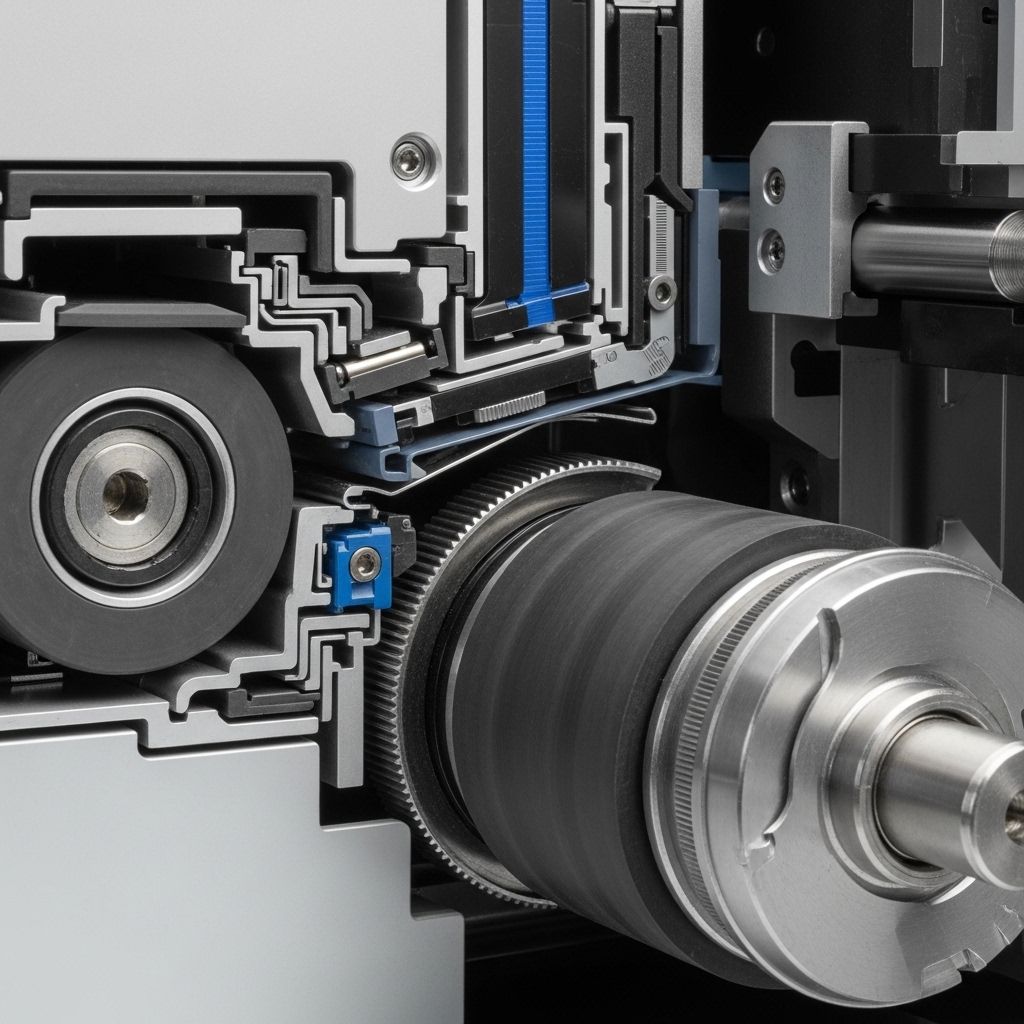
Precision paper transport is a discipline that sits at the intersection of classical tribology, mechanical dynamics, control systems engineering, and materials science. The central engineering challenge is to advance a compliant, hygroscopic, dimensionally variable substrate (paper) through a defined geometric path with positional accuracy in the sub-millimeter range — while maintaining this accuracy at velocities that can exceed 0.5 m/s, over tens of thousands of print cycles, across a wide range of media weights (60–300 g/m²), ambient humidity conditions (10–85% RH), and temperature environments.
The Coulomb Friction Model and Nip Mechanics
The fundamental force model governing paper transport in a drive-roller system is the Coulomb friction law, which states that the maximum tangential (driving) force F_T that can be transmitted to the paper without slippage is limited by:
The normal force at the nip is generated by a spring-loaded pinch roller opposing the drive roller. The spring rate and preload must be calibrated to deliver sufficient clamping force for the heaviest supported media weight while avoiding excessive force that causes visible surface marking on glossy coated papers. This opposing constraint defines a design envelope rather than a single design point, and multiple spring configurations are often employed — selected automatically by the paper weight detection system — in high-end production inkjet architectures.
Hertzian Contact Mechanics at the Roller-Paper Interface
The idealized Coulomb friction model treats the contact between roller and paper as a mathematical point or line. In reality, the soft rubber roller surface deforms elastically under the applied normal force, creating a finite contact patch whose geometry determines the pressure distribution and the effective friction coefficient at the interface.
For a cylindrical rubber roller of radius R pressed against a flat paper surface under normal load P per unit length, Hertzian contact theory predicts a contact half-width a:
The pressure distribution across this contact patch is not uniform — it follows a semi-elliptical profile with maximum pressure at the center and zero at the edges. The frictional force distribution across the patch is similarly non-uniform, with stick zones near the inlet of the nip and slip zones near the exit, as described by the classical Mindlin partial-slip contact model. This stick-slip distribution at the micro-scale is the root cause of paper advance velocity perturbations that manifest as banding artifacts in prints with uniform fill areas.
Drive Roller Materials: Engineering the Friction-Durability Tradeoff
Roller materials must simultaneously satisfy requirements for adequate friction coefficient, controlled compliance (Shore A hardness 40–60), dimensional stability over temperature and humidity, resistance to chemical contamination from ink aerosol, and long service life without significant hardness increase (hardening causes friction coefficient reduction and advance accuracy degradation).
Natural rubber and EPDM (ethylene propylene diene monomer) formulations historically dominated inkjet roller applications, offering excellent initial friction properties. However, their tendency to absorb ink solvents — particularly glycerol-based co-solvents in aqueous inks — causes swelling and surface energy modification that reduces the static friction coefficient over time. Modern formulations favor silicone rubbers modified with high-surface-energy fillers, or thermoplastic polyurethane elastomers (TPUs), which offer superior chemical resistance while maintaining the compliance necessary for conformal contact with paper surface texture.
Encoder Strip Systems and Closed-Loop Position Control
Open-loop stepper motor drive systems cannot meet the sub-100-µm positional accuracy required for high-quality inkjet output. Modern systems employ DC brushless servo motors with closed-loop position feedback provided by a linear optical encoder reading a transparent encoder strip stretched parallel to the paper transport axis.
The encoder strip is a precision-ruled optical grating on a polyester or glass substrate, with line pairs at densities of 1200–2400 lpi (lines per inch). A photodetector array reads the transmitted light intensity as the strip (or the reader head) moves, generating two sinusoidal signals in quadrature (90° phase offset) that allow the controller to detect both position magnitude and direction. The digital interpolation of these signals — typically at 16× or 32× oversampling — provides effective encoder resolution of:
The control loop bandwidth must be high enough to compensate for roller eccentricity (typically ±5–20 µm radial runout in precision-ground rollers) and thermal expansion of the roller shaft (approximately 12 µm/m/°C for steel) within a single paper advance increment. Insufficient bandwidth results in advance distance variability that appears as horizontal banding — one of the most visually objectionable artifacts in inkjet output.
Vacuum Platen Systems and Media Flatness
Maintaining the paper in a precisely flat plane within the print zone — at a defined standoff distance from the printhead face (typically 0.5–3 mm, depending on media thickness and desired dot placement accuracy) — is a challenge that becomes progressively more difficult as media weight decreases (low-weight papers have lower bending stiffness) and as ink loading increases (the differential swelling of the paper surface relative to its unprinted rear causes cockle waving in the wet zone).
Vacuum-assist platens, in which a perforated aluminum or stainless steel platen surface draws a controlled vacuum through the paper, provide the most reliable flatness control across media weight ranges. The vacuum pressure applied must be calibrated to hold the paper flat without impeding transport — excessive vacuum creates frictional drag that exceeds the encoder-controlled drive motor's compensation capability and introduces systematic advance errors.
Tribological Degradation and Roller Maintenance Models
Over the service life of a paper transport system, the roller surface undergoes progressive tribological degradation: surface abrasion reduces the effective Ra roughness profile (increasing real contact area and initially increasing friction), followed by glazing (densification and hardening of the surface layer under repeated compressive loading), which ultimately reduces friction coefficient and advance force. Simultaneously, paper fiber debris and ink particulate accumulate in the roller surface micro-texture, further modifying its tribological properties.
Predictive maintenance models for high-duty-cycle production inkjet systems parameterize roller degradation as a function of total advance distance (in meters), peak media weight, ink coverage per sheet, and ambient humidity. These models, calibrated against measured friction coefficient data from accelerated wear testing, enable predictive scheduling of roller replacement before the advance accuracy falls below the specified threshold — typically ±50 µm maximum advance error per sheet for commercial-quality output.