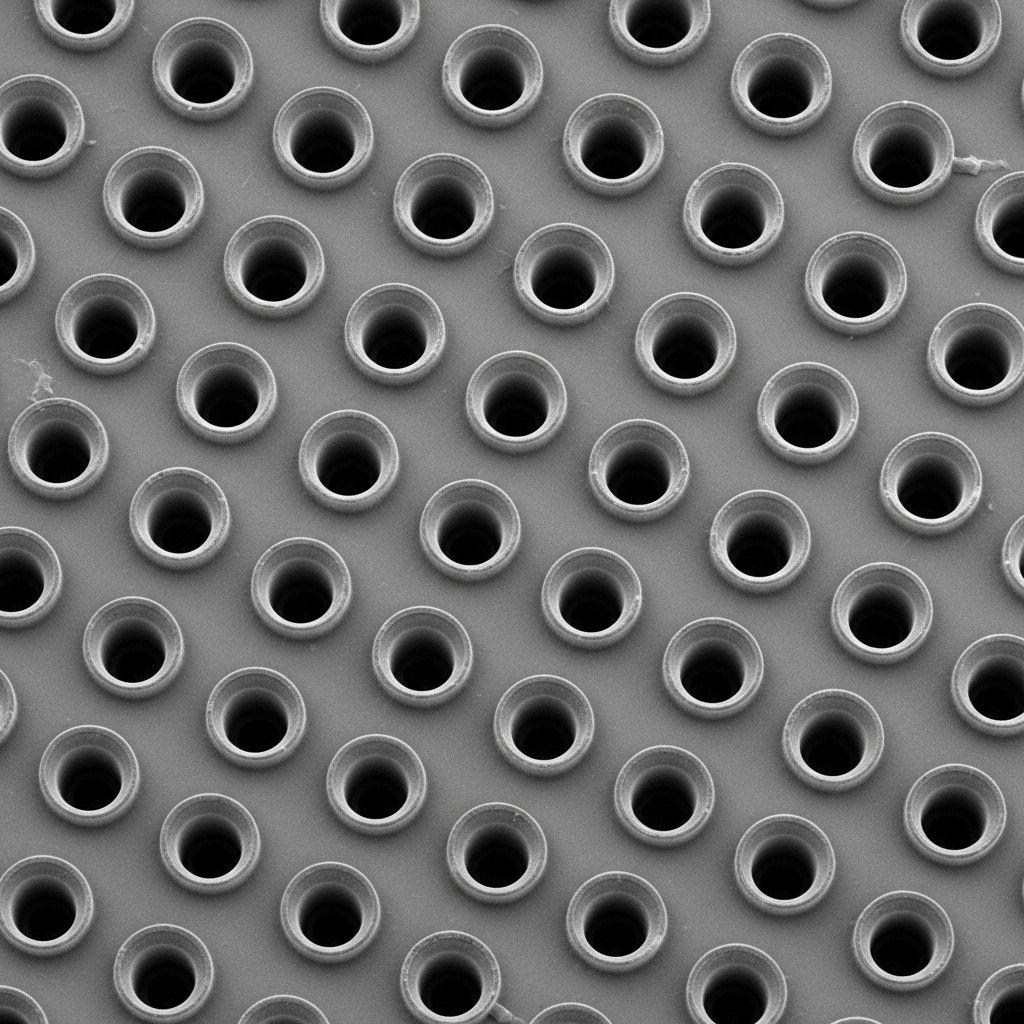
The modern inkjet printhead is among the most precisely engineered electromechanical devices in consumer and industrial production — a system that must generate, deliver, and eject microscopic fluid volumes at kilohertz frequencies while maintaining positional accuracy below one micrometer. At its core lies a deceptively simple physical principle: the inverse piezoelectric effect. Yet the engineering required to translate this quantum-mechanical phenomenon into a reliable, high-density, multi-nozzle array capable of producing photographic-quality output represents decades of materials science, MEMS fabrication research, and fluid dynamic modeling.
The Inverse Piezoelectric Effect: From Crystal Lattice to Mechanical Displacement
Piezoelectricity — from the Greek piezo, to press — describes the generation of an electric charge in certain crystalline materials in response to applied mechanical stress (direct effect), and conversely, mechanical deformation in response to an applied electric field (inverse effect). The phenomenon originates in the non-centrosymmetric crystal structures of specific materials, where the application of an electric field shifts the positions of cation and anion sublattices relative to each other, producing a net macroscopic strain.
In printhead engineering, the material of choice has been lead zirconate titanate (PZT, Pb[Zr₍ₓ₎Ti₍₁₋ₓ₎]O₃) — a perovskite ceramic whose piezoelectric response is orders of magnitude larger than that of naturally occurring quartz. The composition ratio x in the PZT formula is tuned to operate near the morphotropic phase boundary (MPB) between the rhombohedral and tetragonal crystal structures, where the piezoelectric coefficients d₃₁ and d₃₃ reach their maximum values.
In thin-film micro-piezo architectures, the PZT layer is deposited at thicknesses of 1–5 µm via sol-gel spin coating or sputtering onto a flexible membrane substrate. When a drive voltage of typically 20–40 V is applied across this layer, the resulting transverse strain (d₃₁ mode) causes the composite membrane to deflect toward the underlying ink channel, generating the pressure pulse required for ejection.
Actuator Geometry: Chamber Design and Pressure Amplification
The geometry of the ink pressure chamber directly beneath the PZT actuator membrane is a primary determinant of acoustic efficiency — the fraction of the mechanical energy stored in the deflecting membrane that is converted into useful fluid kinetic energy at the nozzle.
Two principal architectural configurations exist in commercial printheads. In the push-mode configuration, the PZT membrane deflects downward into the ink chamber, compressing the fluid volume and driving a pressure wave toward the nozzle. In the bend-mode design (also termed the roof-shooter configuration), the membrane bends across its entire span, and the pressure generated by the volume change at the membrane's center drives the ejection event.
The acoustic resonance frequency of the ink chamber and the drive waveform dwell time must be precisely matched to achieve constructive interference between the pressure waves generated at the membrane and the reflected waves from the nozzle. This resonant amplification can increase effective driving pressure by 30–60% above the baseline membrane displacement value.
Modern industrial printheads incorporate shear-mode PZT actuators — where the applied field causes shear deformation of the ceramic walls between adjacent ink channels — enabling channel densities of 360 nozzles per inch or higher within a single monolithic piezo block. This architecture, pioneered in the late 1990s, is the foundation of the high-speed industrial heads used in packaging and textile applications.
Drive Waveform Engineering
The electrical waveform applied to each PZT actuator is not a simple square pulse — it is a precisely shaped multi-segment voltage profile that governs every aspect of the droplet formation event. The four critical segments of a standard trapezoidal drive waveform are the pre-pulse phase (an initial negative displacement to pre-fill the chamber), the rise segment (rapid voltage increase causing membrane deflection), the dwell phase (a hold at maximum displacement, timed to the acoustic resonance period of the ink chamber), and the fall segment (return to zero, timed to generate a second pressure wave that pinches off the droplet and retracts the trailing ligament).
The dwell time — typically in the range of 3–8 µs for a standard printhead chamber geometry — is the most sensitive parameter. Deviations of even 0.5 µs from the optimal dwell duration can shift the droplet velocity by several meters per second or induce satellite formation. Drive waveforms are empirically optimized using stroboscopic droplet visualization and iterative voltage profile adjustment during the printhead qualification process.
Acoustic Crosstalk in High-Density Nozzle Arrays
When multiple nozzles in a dense array fire simultaneously or in rapid succession, the pressure waves generated by each actuator propagate not only toward the intended nozzle but also laterally through the ink manifold and through the structural compliance of the printhead body. This acoustic cross-coupling — or crosstalk — modulates the effective chamber pressure of neighboring nozzles, causing variability in the droplet volume and velocity of adjacent channels.
Engineers mitigate crosstalk through several strategies: acoustic isolation grooves machined between adjacent chamber structures, compliant compliance layer materials that attenuate lateral wave propagation, and electronic firing sequence optimization (interleaving firing of neighboring nozzles to temporally separate their acoustic events). In simulation, finite element acoustic models of the full nozzle array are used to predict crosstalk coefficients and guide the printhead geometry optimization prior to silicon mask tape-out.
MEMS Fabrication of High-Density Nozzle Plates
The nozzle plate — the final layer through which the ink is ejected — is fabricated using silicon deep reactive-ion etching (DRIE) or electroformed nickel processes to achieve nozzle diameters in the range of 10–25 µm with circularity tolerances below ±0.5 µm. The interior nozzle taper angle is a critical geometric parameter: a converging taper (inlet to exit) increases jetting velocity through Bernoulli pressure conversion, while the meniscus geometry at the nozzle exit plane determines the static contact angle and the threshold pressure for meniscus break-through versus retraction.
Nozzle surfaces receive hydrophobic treatment — typically a thin fluoropolymer coating applied by vapor deposition — to prevent ink from wetting the nozzle plate exterior and forming parasitic droplets that degrade print quality. The dynamic contact angle of the ink on this treated surface must be maintained above 70° throughout the operational life of the printhead to ensure clean droplet separation at the nozzle exit.
Thermal Management and Viscosity Control
Because ink viscosity varies strongly with temperature (a typical aqueous inkjet ink with 3 mPa·s at 25 °C may drop to 1.5 mPa·s at 45 °C), printhead assemblies incorporate localized resistive heaters to maintain the ink at a controlled operating temperature — typically 30–40 °C — independent of ambient conditions. This thermal regulation serves dual purposes: it maintains the Ohnesorge number within the stable jetting design window, and it ensures consistent acoustic resonance properties of the ink, since acoustic velocity in the fluid is temperature-dependent.
The combination of precise waveform control, optimized chamber acoustics, MEMS-quality nozzle fabrication, and active thermal management in a modern micro-piezoelectric printhead represents one of the most sophisticated integration challenges in precision consumer mechatronics — delivering droplet placement precision of sub-micron accuracy at ejection rates approaching the physical limits of the underlying fluid mechanics.