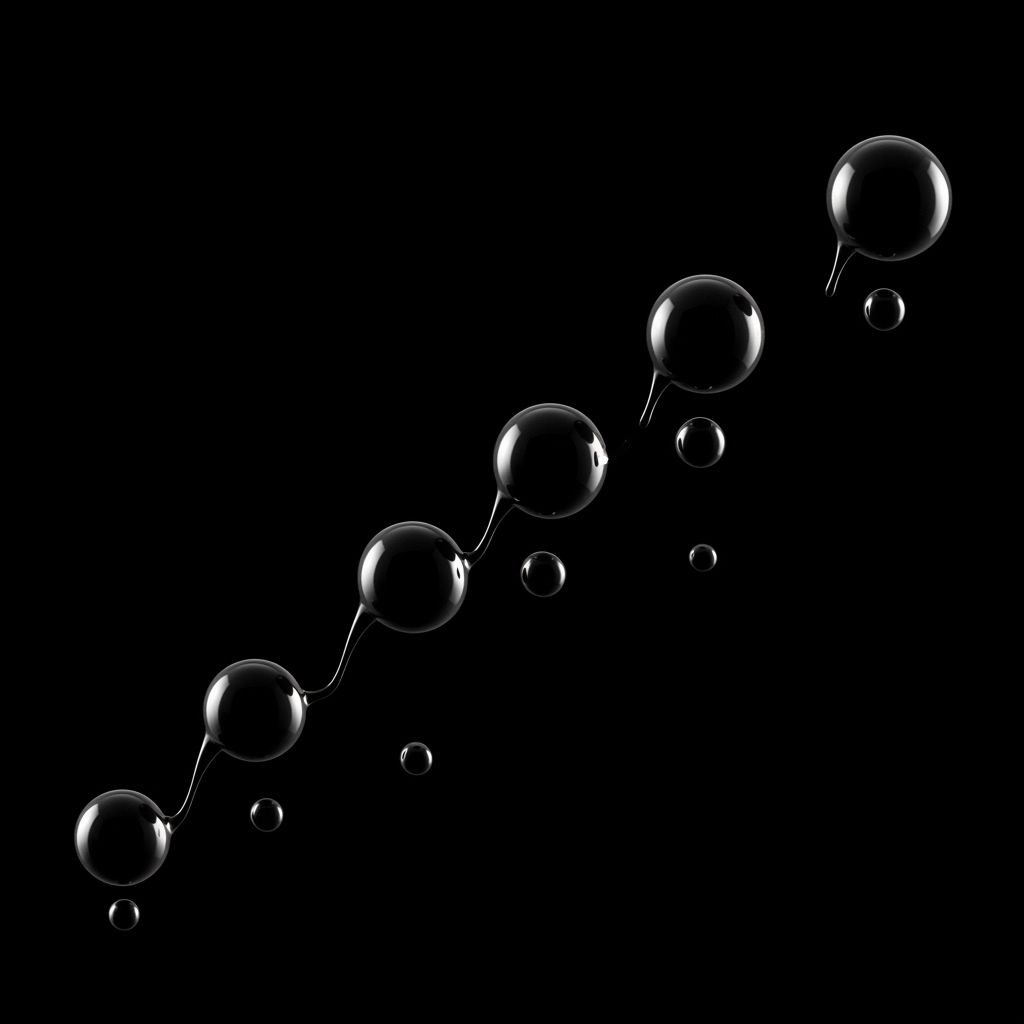
The formation of a single ink droplet in a drop-on-demand (DOD) inkjet system is a sequence of fluid mechanical events that unfolds over a temporal window of twenty to eighty microseconds and involves length scales ranging from the macroscopic ink channel (millimeter scale) down to the nozzle exit meniscus (micron scale). Despite the apparent simplicity of "squeezing ink through a hole," the physics of droplet formation is governed by the nonlinear interplay of three competing forces — inertia, viscosity, and surface tension — whose balance determines whether a stable, isolated, satellite-free droplet emerges or whether the ejection event produces a cascade of unwanted secondary droplets that degrade print resolution.
The Three Governing Forces and the Ohnesorge Framework
In the dimensionless analysis of inkjet drop formation, three physical forces dominate the behavior of the fluid jet emerging from the nozzle. Inertia — characterized by the fluid density ρ and the flow velocity V — drives the ejection. Surface tension σ resists the deformation of the liquid-air interface and acts to minimize the surface area of any fluid structure, including the ejected jet and the meniscus. Viscosity η dissipates kinetic energy within the fluid by resisting shear deformation.
The Ohnesorge number (Oh) consolidates these forces into a single dimensionless ratio:
Below the lower Ohnesorge threshold (Oh < 0.1), surface tension dominates and the jet spontaneously breaks up into droplets via Plateau-Rayleigh instability even without a driving pressure pulse — a regime useful for continuous inkjet but problematic for precise DOD. Above the upper threshold (Oh > 1.0), viscous dissipation is so large that it prevents the jet from forming discrete droplets cleanly; instead, the ink forms long ligaments that retract back into the nozzle, and ejection requires impractically high driving energies.
The Droplet Formation Timeline
High-speed stroboscopic imaging at effective frame rates of 10⁶ fps and above has enabled researchers to resolve the complete ejection event into distinct phases. In the first phase (typically 0–5 µs after drive pulse onset), the pressure wave generated by the PZT actuator reaches the nozzle meniscus. If the pressure exceeds the Laplace pressure threshold — defined as ΔP = 4σ/d for a circular nozzle of diameter d — the meniscus bulges outward and begins to form a proto-droplet.
In the second phase (5–20 µs), the meniscus elongates into a cylindrical ligament as the pressure wave continues to drive fluid through the nozzle. The head of this ligament accelerates to velocities of 6–14 m/s, while the rear of the ligament (still connected to the nozzle) decelerates as the actuator membrane returns toward its rest position and begins to generate a negative pressure pulse (refill phase).
The transition from cylindrical ligament to spherical droplet is driven by the Rayleigh-Plateau instability: surface tension energy is minimized when a cylinder of fluid breaks into spheres. The instability grows at a characteristic wavelength λ_max = 2π√2 × r (where r is the ligament radius), and the time for breakoff scales with the capillary time τ_c = √(ρr³/σ).
Satellite Droplet Formation and Suppression
The most critical quality challenge in DOD inkjet fluid dynamics is the formation of satellite droplets — small secondary drops that detach from the trailing end of the ligament after primary droplet pinch-off. These satellites arrive at the paper surface at a different time and slightly different trajectory than the primary droplet, producing ghost marks and reducing the sharpness of fine text and line features at resolutions above 600 dpi.
Satellites form when the trailing ligament, after primary droplet detachment, does not retract cleanly back into the nozzle. Instead, if the ligament length exceeds a critical multiple of its diameter (approximately 3.5 × diameter, per Rayleigh stability analysis), it undergoes secondary pinch-off at a location determined by the Rayleigh instability growth rate profile along the ligament. The resulting satellite volume is typically 1–15% of the primary droplet volume.
Engineering strategies for satellite suppression include: waveform optimization (timing the falling edge of the drive pulse to generate a retraction wave that pulls the trailing ligament back before it pinches), ink formulation adjustment (increasing viscosity to damp secondary oscillations, while remaining within the upper Oh boundary), and nozzle geometry modification (adding a chamfered or converging nozzle inlet that increases the fluid velocity at nozzle exit and reduces ligament length).
Meniscus Recovery and Maximum Jetting Frequency
After each ejection event, the nozzle meniscus must recover to its rest position before the next drive pulse can be applied. The recovery is governed by the acoustic ringing in the ink channel (the residual pressure oscillations after the primary droplet event) and the capillary restoring force at the nozzle. The characteristic recovery time defines the maximum jetting frequency of the printhead.
In contemporary high-frequency designs, acoustic damping features — including compliant membrane sections within the ink supply path and precisely tuned chamber geometries — reduce the residual acoustic oscillation amplitude to below the meniscus breakthrough threshold within 40–60 µs of the initial ejection event, enabling stable jetting at frequencies approaching 21 kHz. This corresponds to a maximum theoretical single-pass swath speed, for a 1200-nozzle array with 360 npi spacing, of approximately 1.8 m/s.
Computational Fluid Dynamics Modeling of Droplet Formation
The complexity of the coupled actuator-ink-nozzle system renders purely analytical approaches insufficient for printhead design optimization. Modern inkjet development relies on finite element and volume-of-fluid (VOF) computational fluid dynamics simulations to predict droplet volume, velocity, shape, and satellite behavior under arbitrary drive waveform inputs. The VOF method tracks the evolving liquid-air interface through the Navier-Stokes equations augmented by a surface tension source term (Continuum Surface Force model, Brackbill et al.), enabling quantitative prediction of ligament breakoff, satellite formation, and meniscus recovery dynamics without empirical parameter fitting.
The convergence of high-fidelity CFD models with stroboscopic experimental validation has reduced the printhead development iteration cycle from years of physical prototype testing to months of simulation-guided design, accelerating the pace at which new ink formulations and nozzle geometries can be qualified for production.