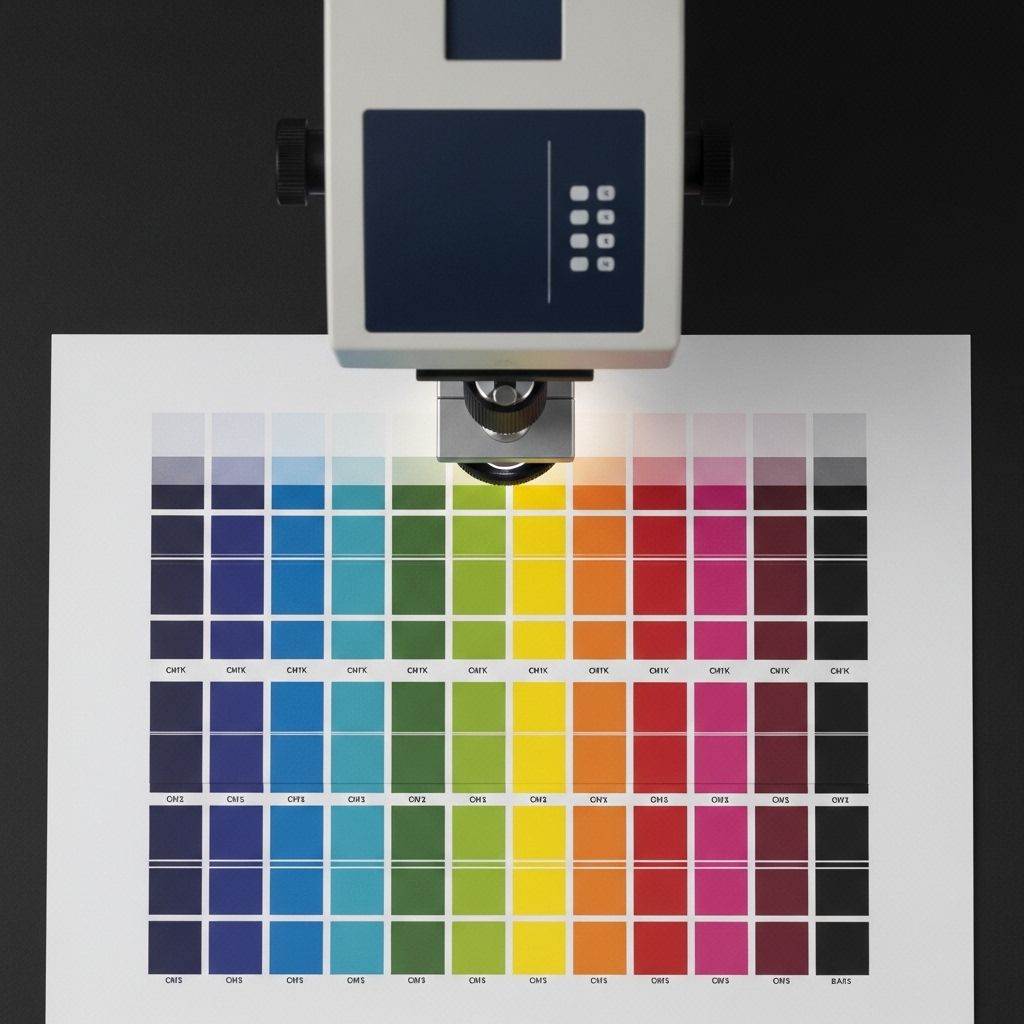
The fundamental question of how a printed page reconstructs the visual experience of a photographic scene — or any continuous-tone image — involves a chain of physical and perceptual processes that spans from the quantum mechanics of photon-pigment interaction to the neurophysiology of trichromatic human vision. At the engineered center of this chain lies the CMYK color model: a system of four ink layers whose cumulative spectral absorption profile, modulated by halftone geometry, generates the perception of millions of distinct hues from a combinatorial space of only four primary colorants.
Additive vs. Subtractive: The Fundamental Physical Distinction
The RGB color model describes the additive synthesis of light: the superimposition of red (~700 nm), green (~546 nm), and blue (~435 nm) primary light sources in varying intensities to reconstruct any chromaticity within the triangular RGB gamut on the CIE 1931 chromaticity diagram. In display technology, each sub-pixel emits radiant energy; the eye sums these emissions, and at full intensity of all three primaries, the perception of white results.
CMYK operates on the complementary physical principle of subtractive synthesis. Inks are not light sources — they are spectrally selective absorbers. Cyan ink absorbs the red portion of the visible spectrum (~580–700 nm), reflecting blue and green. Magenta ink absorbs green wavelengths (~480–580 nm), reflecting red and blue. Yellow ink absorbs blue wavelengths (~400–480 nm), reflecting red and green. The perceived color of a printed area is the complement of the absorbed spectrum under the illuminant.
When cyan, magenta, and yellow ideal filters are stacked, they collectively absorb red + green + blue — theoretically removing all visible wavelengths and producing black. In reality, the spectral impurity of real-world organic pigments means this composite produces a dark brown-grey, necessitating a dedicated black (Key) channel to achieve neutral shadow reproduction and deep shadow density.
The Physics of Pigment Absorption: Chromophore Molecular Structure
The selective wavelength absorption that gives a pigment its color originates in the electronic structure of the chromophore molecule. Extended systems of conjugated pi bonds — alternating single and double bonds along a molecular backbone, as found in the phthalocyanine ring system of cyan pigment or the anthraquinone backbone of certain magenta colorants — create energy levels with separations that fall within the visible photon energy range of 1.8–3.1 eV (400–700 nm).
A photon of wavelength matching a pi-to-pi* electronic transition is absorbed by the chromophore, elevating an electron from the ground state to an excited state. The remaining transmitted and reflected photons constitute the perceived color of the material. The specific absorption wavelength (and bandwidth) is determined by the precise molecular architecture: the length of the conjugated chain, the nature and positions of auxochrome substituents, and the electronic coupling between adjacent aromatic ring systems.
Halftone Geometry: Constructing Continuous Tone from Binary Dots
An inkjet printhead deposits binary ink dots — either a dot is present or absent at any given location. Yet printed photographs appear to contain smooth gradients. This perceptual continuity is achieved through spatial halftoning: the modulation of the local density of ink dots within a small spatial area. The eye's optical point spread function integrates the pattern over the spatial resolution limit of human vision (approximately 1–2 arc-minutes at normal reading distance), averaging the local dot density into a continuous tone percept.
Modern inkjet halftoning employs error diffusion or stochastic (blue noise) screening algorithms rather than classical clustered-dot halftone rosettes. In error diffusion, the quantization error introduced by rounding the continuous-tone pixel value to a binary output is propagated to neighboring pixels according to a diffusion kernel (Floyd-Steinberg: 7/16, 3/16, 5/16, 1/16 distribution). This produces halftone patterns with a pseudo-random, visually grain-like texture that avoids the moiré patterns associated with periodic clustered screens in multi-color overprint scenarios.
ICC Color Management: Bridging RGB Capture to CMYK Output
The ICC (International Color Consortium) profile system provides the mathematical infrastructure for color space transformations between device-dependent color spaces (sRGB from a camera sensor, or CMYK from a specific ink-on-paper combination) and the device-independent CIE L*a*b* color space, which represents perceptual distances in a three-dimensional Euclidean model of human color perception.
A printer ICC profile characterizes the gamut of achievable CMYK combinations on a specific substrate under a defined illuminant (typically D50, the CIE standard print illuminant at 5003 K correlated color temperature). The gamut boundary is described by a three-dimensional hull in CIE Lab space. When an RGB image is converted to CMYK via the profile, the gamut mapping algorithm must make decisions about hues that fall outside the printer's gamut — these decisions are encoded in the rendering intent parameter (Perceptual, Colorimetric, Saturation, or Absolute Colorimetric), each representing a different mathematical strategy for compressing the source gamut into the achievable print gamut.
Multi-Channel Inkjet and Extended Gamut Systems
High-end photographic and fine-art inkjet systems extend beyond the four-channel CMYK framework by adding light cyan, light magenta (and sometimes grey and light grey) channels. These additional diluted channels serve a perceptual rather than purely colorimetric function: they reduce the visibility of individual halftone dots in highlight and midtone regions by replacing high-frequency binary dot patterns of dense ink with lower-frequency patterns of diluted ink, improving the smoothness of skin tones and sky gradients at the cost of a more complex ink management system.
Industrial wide-format systems may use seven or more channels — adding red, green, orange, and violet primaries — to achieve gamut volumes that significantly exceed sRGB, enabling accurate reproduction of the saturated hues found in packaging, fine art originals, and brand identity materials where colorimetric accuracy is a contractual specification. The spectral calibration of these extended gamut systems requires full spectrophotometric characterization across the complete CIEXYZ space, using instruments such as the X-Rite i1Pro 3 or Konica Minolta FD-7 in submillimeter measurement aperture modes.